

Contractor’s Guide to Choosing Airless Sprayers
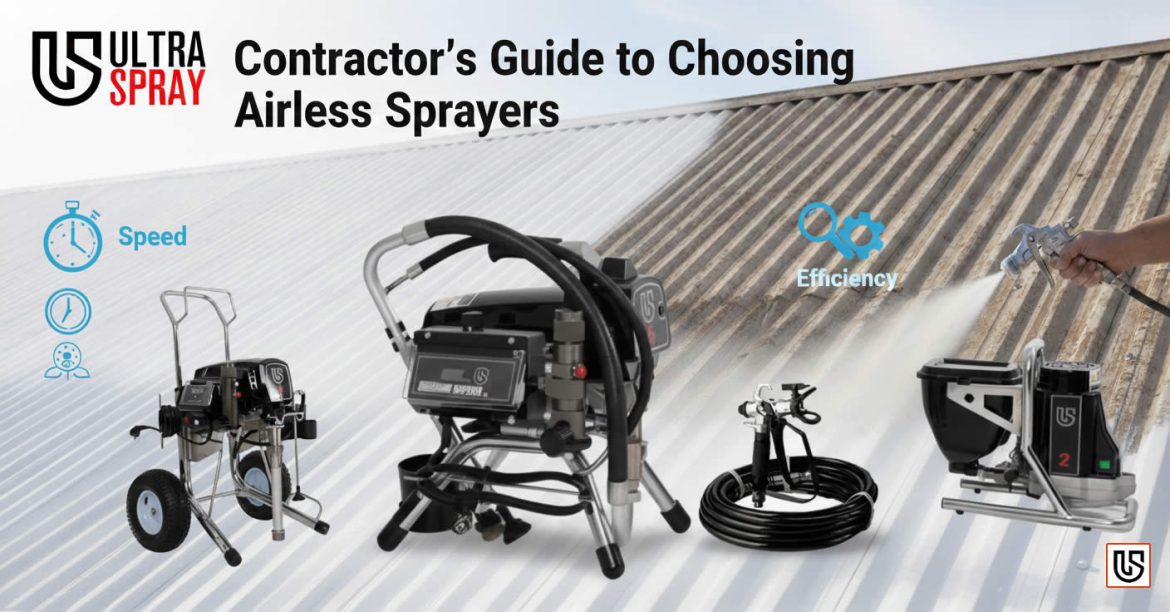
Why the UltraSpray US5 Is the New Industry Standard
If you’ve spent any time on a large-scale roofing or industrial coating project, you already know the pain: a team of four working flat-out with brushes and rollers, fighting the clock, fighting fatigue, and still not delivering the kind of finish your client expects. The good news is that airless spray technology has come a long way — and the UltraSpray US5 Electric Airless Paint Sprayer is quickly becoming the benchmark that serious South African contractors are measuring everything else against.
In this guide, we break down exactly what to look for when choosing an airless sprayer, and why the UltraSpray US5 ticks every box for professionals working in our local conditions.
One Operator. Four People’s Worth of Output.
Let’s talk numbers. A skilled operator running an airless sprayer can cover the same area in a fraction of the time it takes a traditional brush-and-roller crew. On a commercial roof or large facade, that typically means one person with an airless unit can match the output of a four-person team — without the inconsistency that comes from multiple applicators working at different speeds and pressures.
For contractors, this isn’t just about speed — it’s about margin. Fewer workers on site means lower labour costs, fewer scheduling headaches, and more competitive quotes. It also means less time exposed to the elements, which matters enormously in a South African summer roof.
The UltraSpray US5 is built around this single-operator efficiency model. Its 15-metre high-pressure hose gives one person the reach to cover large roof sections — IBR, corrugated, Klip-Lok, and tile — without constantly repositioning the unit. The auto start/stop function means no wasted material and no energy burned when you’re not actively spraying. On a long project day, that adds up significantly.
The Technology Behind the Finish: 1500W, 3300 PSI, and Microcomputer Precision
There’s a reason professional contractors are particular about their sprayer specs. Under-powered equipment means uneven application, tip clogging, and a finish that lets you down — and lets your client down. When you’re offering a “mirror-like” finish as part of your value proposition, your equipment needs to be able to back it up.
Here’s what sets the UltraSpray US5 apart technically:
- 1500W Brushless Motor: Brushless motors run cooler, last longer, and deliver more consistent power than conventional motors. For contractors running long shifts, this means less downtime and more reliable performance at the end of an eight-hour day.
- 3300 PSI Operating Pressure: This level of pressure allows the UltraSpray 5 to atomise a wide range of coatings — from lightweight waterproofing membranes to thicker elastomeric and polyurethane products — without losing spray quality.
- Microcomputer Control with Ultra-Precise Pressure Sensors: This is where the UltraSpray 5 genuinely pulls ahead of cheaper alternatives. The onboard microcomputer constantly monitors and adjusts pressure, ensuring that the first pass and the last pass of the day look exactly the same. Manual pressure adjustments on less sophisticated units are one of the biggest sources of finish inconsistency on site.
For roofing and industrial coating applications, this level of precision isn’t a luxury — it’s what separates a professional result from a call-back.
Built for South Africa’s Conditions: Why Durability Is Non-Negotiable
Anyone who has worked on a construction or roofing site in South Africa knows the environment is punishing. Fine dust, grit, abrasive particles, and harsh UV are a daily reality. Equipment that isn’t built for these conditions doesn’t last — and when a sprayer goes down mid-project, the costs multiply fast.
The UltraSpray US5 addresses this directly through two key design choices:
- Wear-Resistant Alloy Steel Construction: The core components are engineered from high-grade alloy steel, designed to withstand the mechanical stress of continuous high-pressure operation without degrading prematurely.
- Nano-Treated Plunger Rods: This is arguably the most important durability feature for local contractors. The plunger rod is the heart of the pump, and it’s the component most vulnerable to abrasive wear. The nano-surface treatment creates a micro-smooth finish that dramatically reduces friction and particle adhesion — meaning less wear even when you’re spraying in dusty, gritty conditions. For contractors operating on high-traffic sites or in areas with sandy, wind-blown environments, this is the difference between a plunger rod that lasts one season and one that lasts several.
In short, the UltraSpray US5 is engineered to keep working in the same conditions that chew through inferior equipment.
What to Look For When Choosing an Airless Sprayer
Whether you’re evaluating the UltraSpray US5 or any other unit, here’s a quick checklist for professional contractors:
- Motor type and wattage — brushless motors offer superior longevity and consistency for commercial use.
- Operating pressure — ensure the unit can handle the viscosity range of coatings you typically apply.
- Hose length — for roofing and large industrial surfaces, anything under 10 metres will limit your productivity significantly.
- Pressure regulation technology — basic dial controls versus microcomputer-managed pressure sensors is not a trivial difference.
- Durability of wear components — find out what the plunger rods, seals, and pump housing are made of before you commit.
- Energy efficiency features — auto start/stop functionality reduces material waste and operating costs on long projects.
The Bottom Line
The South African contractor market is competitive, and your equipment needs to give you a real edge — in speed, finish quality, and reliability. The UltraSpray US5 Electric Airless Paint Sprayer delivers on all three, combining industrial-grade power with the precision control and durability that local conditions demand.
If you’re still relying on brush-and-roller crews for large-scale commercial or industrial coating projects, the gap between what you’re spending and what you could be earning is wider than you think.
Ready to see what the UltraSpray US5 can do for your operation? Get in touch with the UltraSpray team today.
- Published in Coatings
Airless Spraying Speed vs. Quality
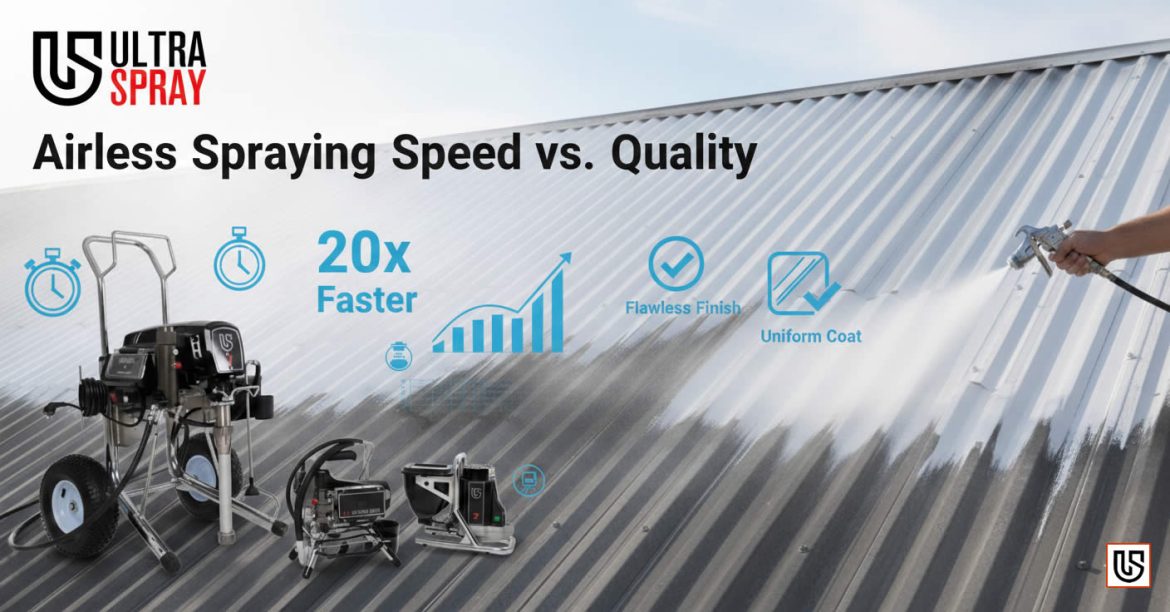
How Airless Spraying Eliminates the “Tack-Free” Wait Time on Large Projects
In most industries, speed and quality are a trade-off. Push too hard for one, and you compromise the other. On large commercial and industrial coating projects, this tension plays out every single day — and it’s one of the reasons why slow-curing, brush-applied coatings have frustrated contractors and their clients for decades.
But a convergence of two technologies is changing this equation entirely: advanced fast-cure coating chemistry and microcomputer-controlled airless spray application. When these two work together, you can coat a commercial roof or industrial structure at speed, walk away with a flawless finish, and have the surface operational within minutes — not hours.
Here’s how it works, and why it matters for your next project.
The “Tack-Free” Breakthrough: Why 1–5 Minutes Changes Everything
“Tack-free” is the technical term for the point at which a freshly applied coating has cured sufficiently that it no longer picks up dust, debris, or contaminants from the environment. For traditional coatings, reaching this state can take anywhere from 30 minutes to several hours — a window during which the surface is vulnerable, the site has to remain closed off, and your crew is standing around waiting.
Specialised fast-cure systems — like the SealPro Cool Roof, a solvent-free rigid acrylic spray coating — compress that window to between one and five minutes. That’s not a marketing figure; it’s a function of the chemistry.
For contractors, this has a cascade of practical benefits:
- No re-work from contamination: Dust settling on a still-tacky surface is one of the most common causes of finish failure on open sites. A five-minute tack-free window dramatically reduces this risk.
- Faster recoat times: Where the coating system requires multiple passes, a rapid initial cure means the next coat can follow almost immediately — compressing a multi-day job into a single site visit.
- Less babysitting of the site: With traditional coatings, someone has to monitor and protect the freshly coated surface for an extended period. Fast-cure systems largely eliminate this overhead.
Keeping Businesses Running While the Roof Gets Done
One of the most underappreciated costs of a commercial roofing or infrastructure project is the disruption it causes to the client’s operations. A manufacturing plant that has to halt production, a warehouse that can’t receive deliveries, or a retail site that has to close sections to the public — all of these represent real financial losses that your client is absorbing while your crew is on their roof.
The combination of fast-cure chemistry and efficient airless application changes this conversation entirely. Consider a typical scenario:
- A large-format warehouse roof is scheduled for a protective polyurethane coating to address UV degradation and waterproofing.
- With traditional application methods and slow-cure coatings, the client would need to clear the warehouse floor of stock, halt forklift operations, and potentially close off receiving bays for a full day or more.
- With a fast-cure airless spray system, the coating is applied in a fraction of the time, reaches tack-free within minutes, and the building can return to operational status the same day — in many cases, the same morning.
This is a significant value-add that contractors can and should be communicating to clients. You’re not just offering a better coating — you’re offering a faster return to normal operations. In competitive tender situations, that’s a compelling differentiator.
The UltraSpray 5’s 15-metre high-pressure hose plays a direct role here too. A single operator can cover large roof sections without the unit needing to be repositioned across the structure, which keeps the application window tight and the disruption footprint small.
Precision Control: Eliminating Overspray in Urban and Sensitive Environments
Speed and fast-cure chemistry mean nothing if overspray lands on your client’s solar panels, a neighbour’s freshly painted wall, or a parked vehicle two properties away. In dense urban and suburban environments — particularly in South Africa’s expanding industrial parks and mixed-use developments — overspray control is not optional. It can be the deciding factor in whether you win repeat business or end up in a dispute.
This is where the microcomputer-controlled pressure regulation of the UltraSpray 5 becomes critically important.
On lesser units, the operator sets the pressure manually and hopes it stays consistent throughout the job. As the coating in the hopper changes viscosity due to temperature fluctuations — a very real factor on a South African summer roof — the spray pattern shifts. What started as a tight, controlled fan can widen unpredictably, sending fine particles well beyond the intended application zone.
The UltraSpray 5’s onboard microcomputer monitors and adjusts pressure in real time through ultra-precise sensors. The practical result:
- Consistent fan pattern throughout the day: Even as ambient temperatures rise and coating viscosity changes, the spray tip delivers the same controlled pattern from the first pass to the last.
- Reduced overspray drift: A stable, correctly pressurised fan atomises the coating at the optimal droplet size — large enough to fall quickly onto the target surface, small enough to achieve proper atomisation and coverage. Pressure spikes create finer particles that drift further.
- Adjustability for different coatings and conditions: The microcomputer control allows precise dialling-in of pressure for different coating products and ambient conditions, rather than relying on operator feel and experience alone.
For contractors working in tight residential streets, on complex industrial facilities with sensitive equipment nearby, or in any environment where overspray is a liability risk, this level of control is an essential feature — not a premium extra.
Putting It All Together: The Professional Advantage
The conversation around airless spraying often gets stuck on surface-level comparisons — motor wattage, PSI ratings, hose length. These specs matter, but they only tell part of the story. The real professional advantage comes from understanding how the right equipment and the right coating system work together to eliminate the friction points that cost contractors time and money:
- Fast-cure coatings like the SealPro Cool Roof remove the waiting game from large-scale application — getting surfaces to a safe, tack-free state in minutes rather than hours.
- Microcomputer-controlled pressure from the UltraSpray 5 ensures that speed doesn’t come at the expense of finish quality or overspray control.
- A single well-equipped operator can deliver a superior finish in a fraction of the time, with minimal disruption to the client’s operations.
In an industry where your reputation is built project by project, having technology that reliably delivers on both speed and quality is as important as the skill you bring to the site.
Want to find out which UltraSpray system is right for your next project? Contact the UltraSpray team for expert advice tailored to your application.
- Published in Coatings